Aftertaste: Unified Customer Resolution Platform
Redesign of a fragmented customer concern management system used across stores, call centres, and corporate teams. The existing ecosystem relied on multiple legacy tools that didn’t communicate with each other, leading to siloed resolutions and no visibility into systemic issues.
Year
2025
Type
B2B • Research • Product Thinking
Collaborators
2 Product Designers + 1 Design Researcher + 1 Design Manager + 1 Product Manager + Engineering Squad + Guest Services Team
My Role
Conducted research across call centres and stores, mapping workflows and staff pain points. I layered these insights with stakeholder and customer conversations to define core jobs-to-be-done. I owned the Store Manager dashboard & Store.ai intervention from concept to prototyping

Start
Development
Discovery and Synthesis
Design and Prototyping
Ideation
Feasibility Validation
Researchers, Designers
Designers
Guest Services, Designers
Eng, PMs, Designers


Problem
Customer complaints were handled on scattered tools with no feedback loop to surface root causes such as training gaps, recurring product issues, or process breakdowns. This led to repeat complaints, inconsistent resolutions, and growing operational overhead for stores.
Goal
Enable store teams to resolve customer concerns within a single system while shifting the mindset from reactive ticket closure to proactive store health management.
Solution
A role-based CRM aligned to store managers’ responsibilities and KPIs. The experience unified complaint resolution and store health improvement into one workflow with AI-assisted root cause analysis, and a lightweight kanban to translate patterns into clear, actionable next steps.

Constraints
The project faced real-world constraints like a legacy system nearing deprecation, high pressure store environments, and fragmented data, so we scoped the first release to store teams to unlock fast operational impact.
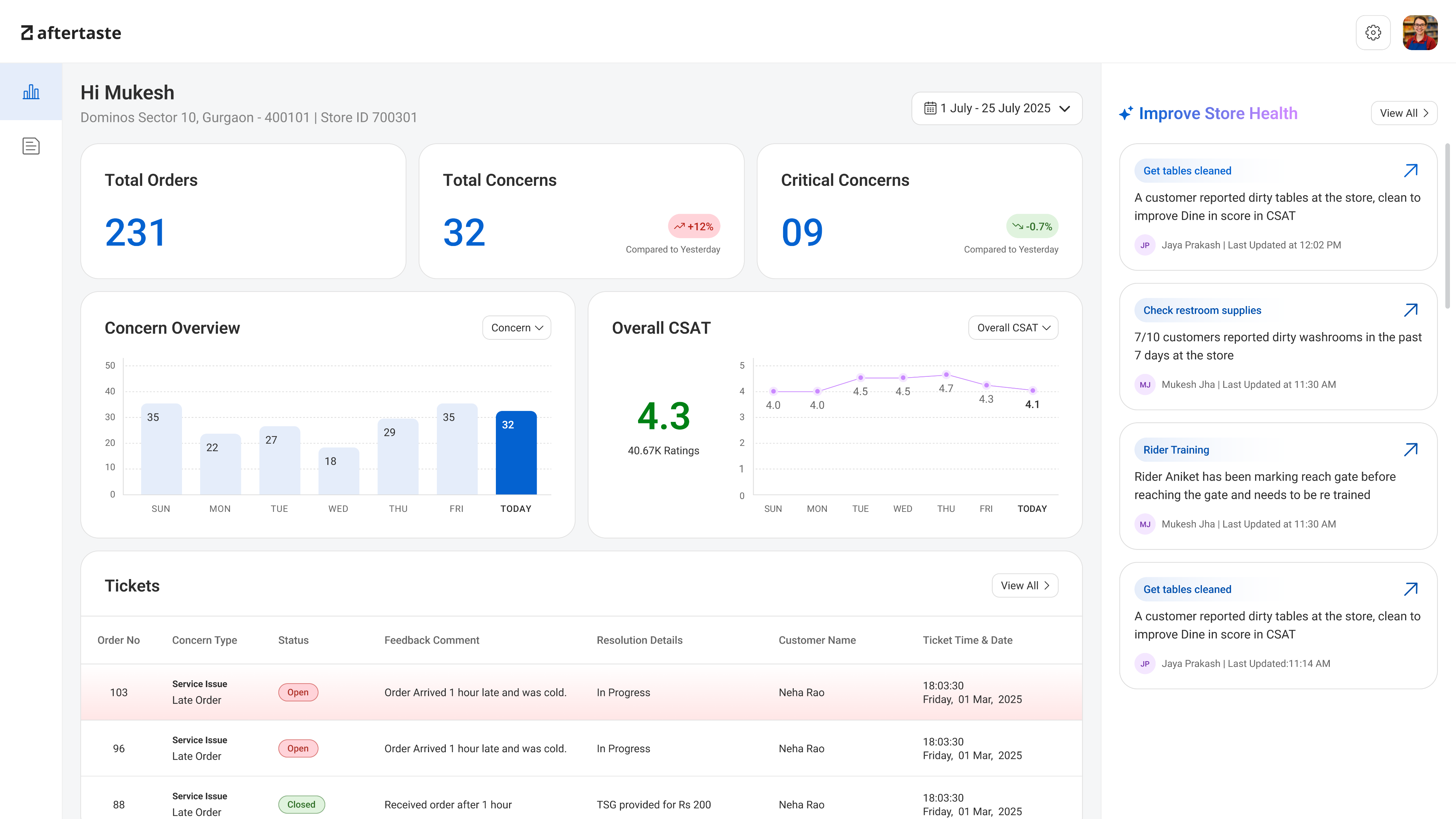
A single view of what matters
Role-based workflows surfaced only the information store managers needed, mapped directly to their KPIs. This reduced cognitive load and enabled faster, more confident decisions during daily operations.
Consolidated ticket context
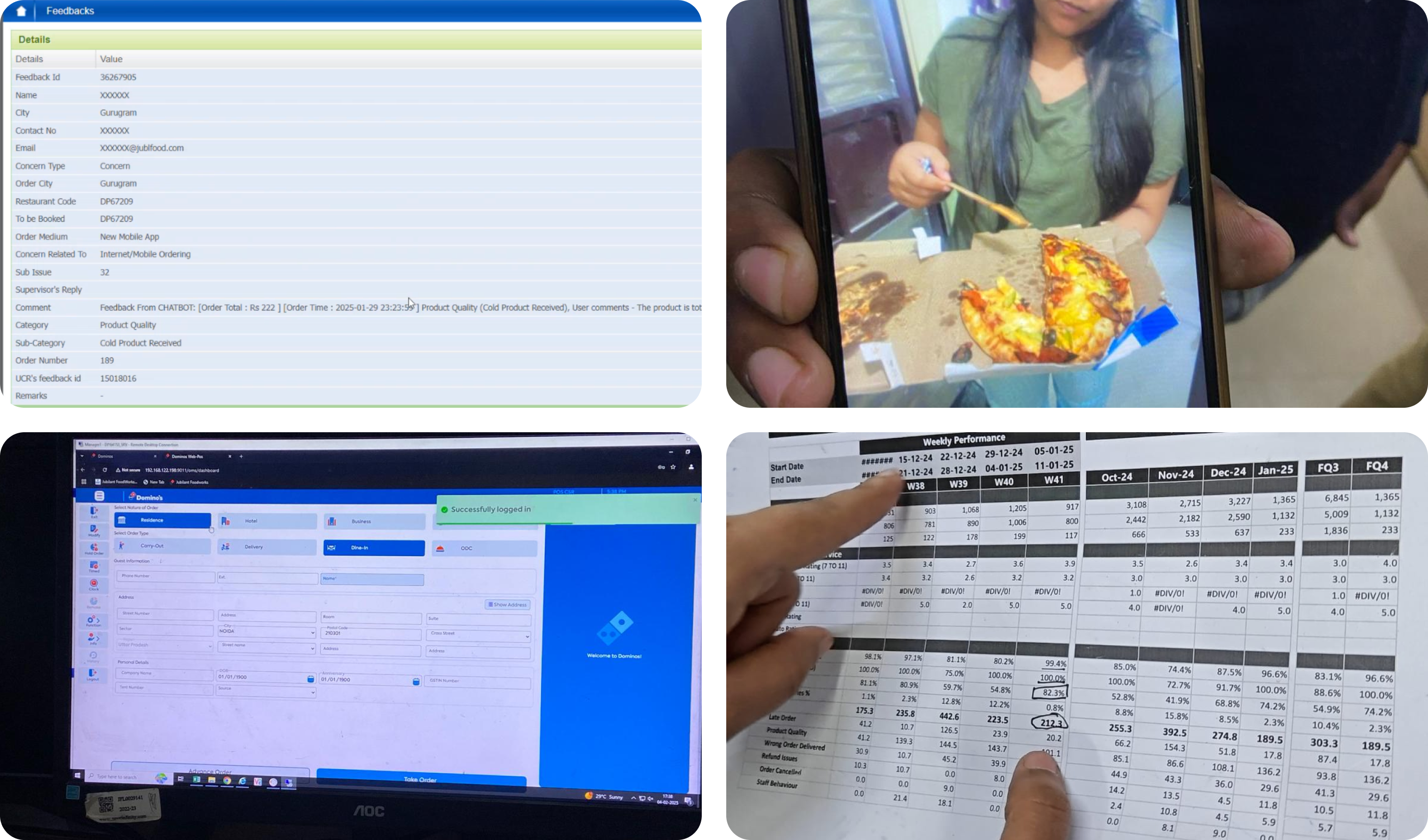
Each ticket opened into a single, consolidated view with customer history, order details, past resolutions, and media to eliminate context switching and enable faster resolution.
AI as a sense-making layer
AI surfaced recurring concern patterns and likely root causes, helping managers identify trends rather than auto-resolve issues. Outputs were intentionally concise and explainable to support human judgment and build trust.
Closing the loop from complain to action
Concerns no longer ended at resolution. A Store Health action layer converted recurring issues into trackable improvement tasks, ensuring learnings translated into operational change.
Side Note
This project taught me to think in systems, not screens. With so much research, it’s easy to over-index on features, but knowing what not to build matters just as much. The result was a modular UI built to scale across JFL brands, user types, languages, and products.
Explore More Work
Elate: Domino’s Customer Facing POS

Next Gen Inventory Management

© 2026 Prakruti Desai
View Full Project

View Full Project
Home
Next Project

Aftertaste: Unified Customer Resolution Platform
Redesign of a fragmented customer concern management system used across stores, call centres, and corporate teams. The existing ecosystem relied on multiple legacy tools that didn’t communicate with each other, leading to siloed resolutions and no visibility into systemic issues.
Year
2025
Type
B2B • Research • Product Thinking
Collaborators
2 Product Designers + 1 Design Researcher + 1 Design Manager + 1 Product Manager + Engineering Squad + Guest Services Team
My Role
Conducted research across call centres and stores, mapping workflows and staff pain points. I layered these insights with stakeholder and customer conversations to define core jobs-to-be-done. I owned the Store Manager dashboard & Store.ai intervention from concept to prototyping

Start
Development
Discovery and Synthesis
Design and Prototyping
Ideation
Feasibility Validation
Researchers, Designers
Designers
Guest Services, Designers
Eng, PMs, Designers


Problem
Customer complaints were handled on scattered tools with no feedback loop to surface root causes such as training gaps, recurring product issues, or process breakdowns. This led to repeat complaints, inconsistent resolutions, and growing operational overhead for stores.
Goal
Enable store teams to resolve customer concerns within a single system while shifting the mindset from reactive ticket closure to proactive store health management.
Solution
A role-based CRM aligned to store managers’ responsibilities and KPIs. The experience unified complaint resolution and store health improvement into one workflow with AI-assisted root cause analysis, and a lightweight kanban to translate patterns into clear, actionable next steps.

Constraints
The project faced real-world constraints like a legacy system nearing deprecation, high pressure store environments, and fragmented data, so we scoped the first release to store teams to unlock fast operational impact.
A single view of what matters
Role-based workflows surfaced only the information store managers needed, mapped directly to their KPIs. This reduced cognitive load and enabled faster, more confident decisions during daily operations.
Consolidated ticket context
Each ticket opened into a single, consolidated view with customer history, order details, past resolutions, and media to eliminate context switching and enable faster resolution.
AI as a sense-making layer
AI surfaced recurring concern patterns and likely root causes, helping managers identify trends rather than auto-resolve issues. Outputs were intentionally concise and explainable to support human judgment and build trust.
Closing the loop from complain to action
Concerns no longer ended at resolution. A Store Health action layer converted recurring issues into trackable improvement tasks, ensuring learnings translated into operational change.
Side Note
This project taught me to think in systems, not screens. With so much research, it’s easy to over-index on features, but knowing what not to build matters just as much. The result was a modular UI built to scale across JFL brands, user types, languages, and products.
Explore More Work
Elate: Domino’s Customer Facing Point of Sale
Next Gen Inventory Management

View Full Project
View Full Project
Home
Next Project