Next Gen Inventory Management
Inventory tracking across 2,500+ Domino’s stores relied heavily on manual registers, Excel and other legacy tools, making it unreliable at scale. The project focused on digitising inventory in a way that worked in fast pace kitchen environment reducing wastage without slowing operations.
Year
2025
Type
B2B • Systems Design • Gamification
Impact
+$7.7M in annual revenue projected

Collaborators
2 Product Designers + 1 Design Researcher + 1 Design Manager + 2 Product Managers + Engineering Squad + Operations Team + Master Data Management Team
My Role
I partnered with our researcher to study on-ground workflows through observations and staff interviews, then worked with PMs on system mapping and solution framing. I owned end-to-end UX, from concept to high-fidelity prototypes for consumption and stock reconciliation modules.

Start
Test
Discovery and Synthesis
Design and Prototyping
Ideation
Feasibility Validation
Staff, Operations, PMs, Designers
Designers
Operations, PMs, Designers
CPO, MDM, Eng, PMs, Designers


Goal
Improve inventory accuracy and visibility across stores to reduce wastage and leakage, unlocking meaningful cost and time savings at scale.
Problem
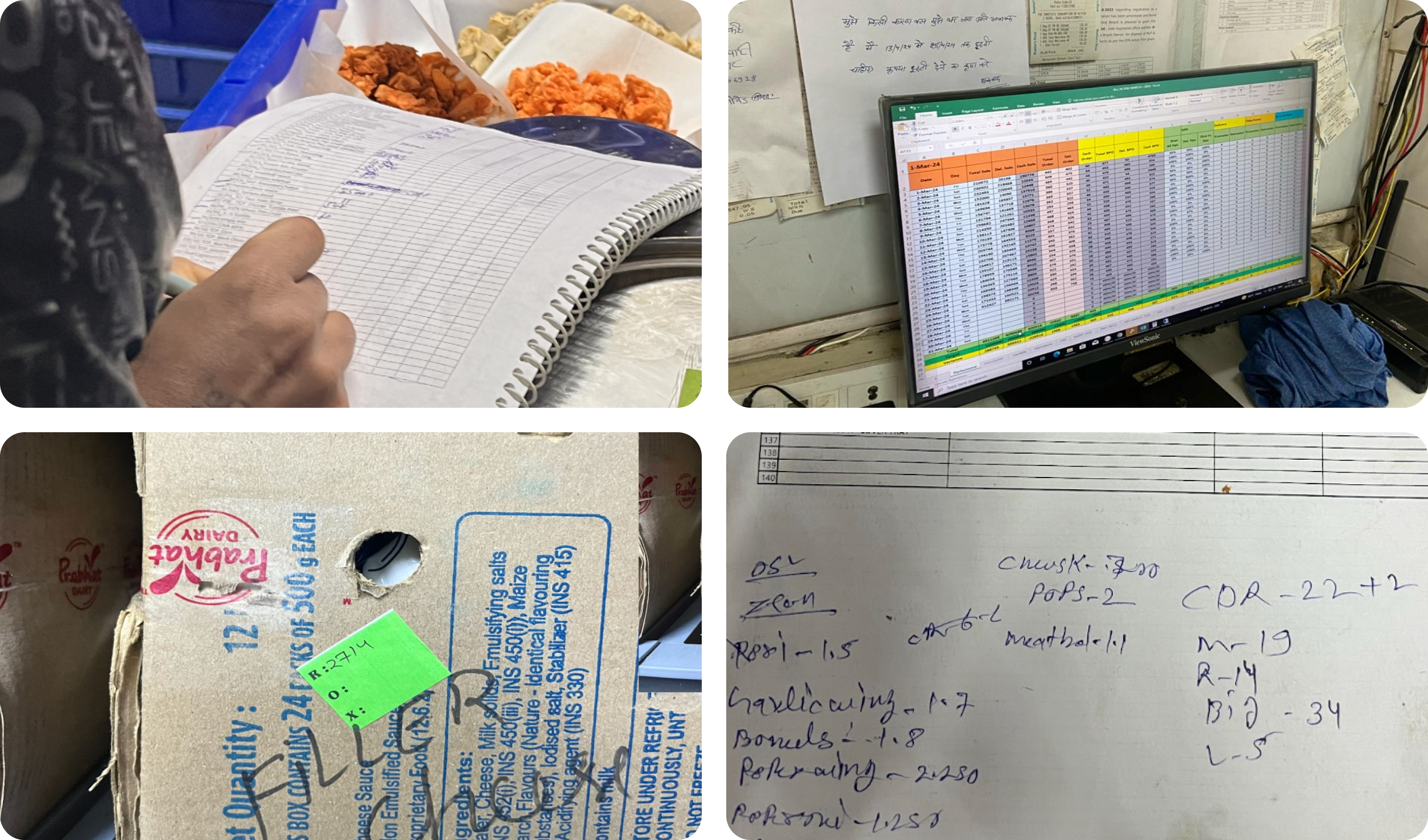
At Domino’s scale, accurate inventory data was critical for daily ordering decisions but the systems generating that data relied heavily on manual effort leading to stock outs, over ordering and revenue leakage.
Solution
A low-friction, QR-based inventory tracking system was designed to capture stock movement in real time, fitting seamlessly into existing kitchen workflows without slowing staff down. Maker checker was added to reduce misuse, & key tasks were lightly gamified to keep staff motivated.

Module 1: Consumption
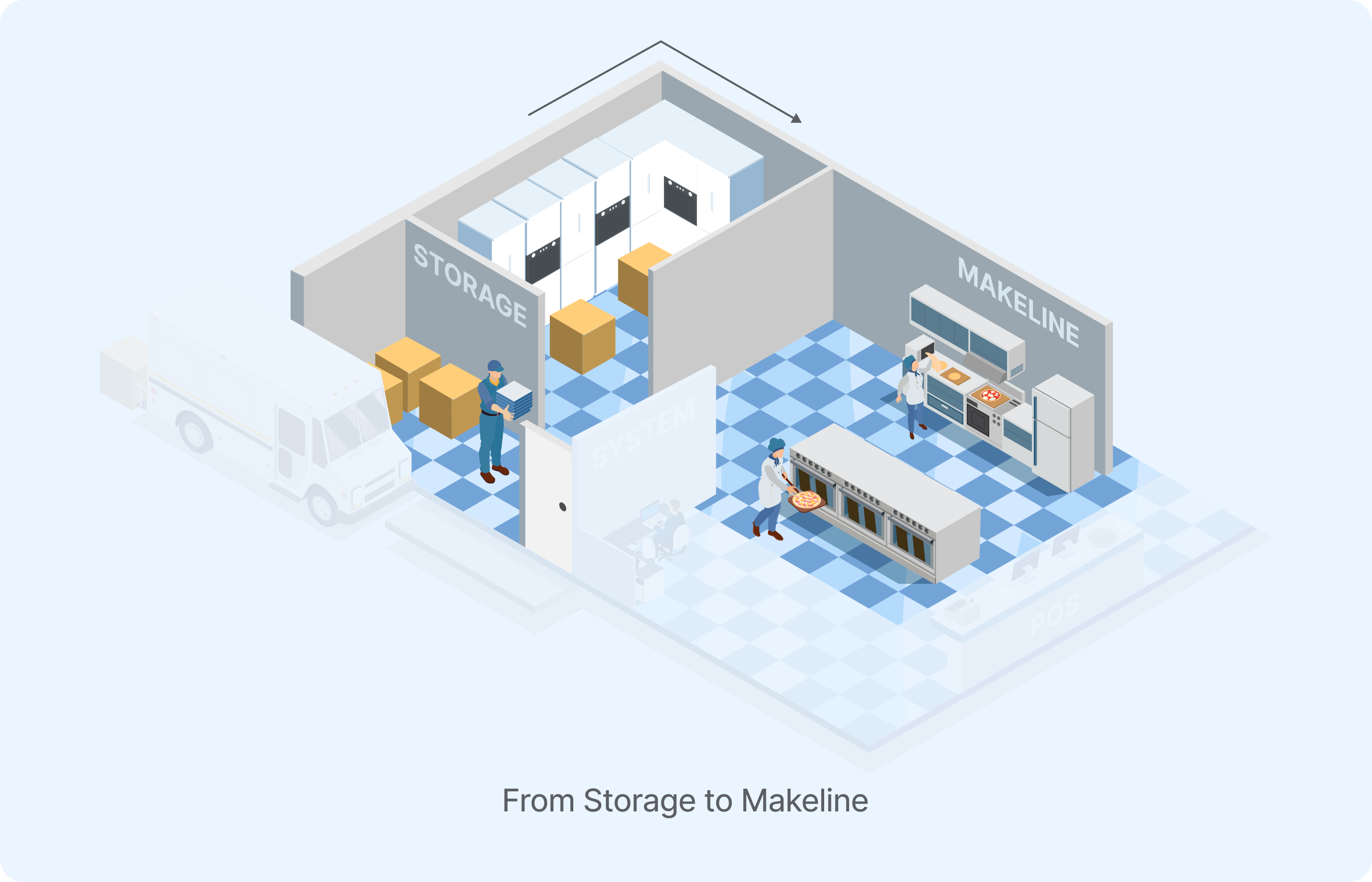
Consumption is the usage of materials as they move from storage to the makeline. This movement wasn’t tracked in real time leading to wastage, and reactive decision-making.
Constraints
The system had to work during peak-hour pressure, where staff couldn’t absorb additional cognitive or operational load. It also needed to be easy to learn and adopt in a high-turnover store environment.
Constraints
For reconciliation, the hardest constraints were fatigue at end-of-day, high SKU volume, and low incentive alignment. These made accuracy difficult even for well-intentioned staff.
Debating the Direction
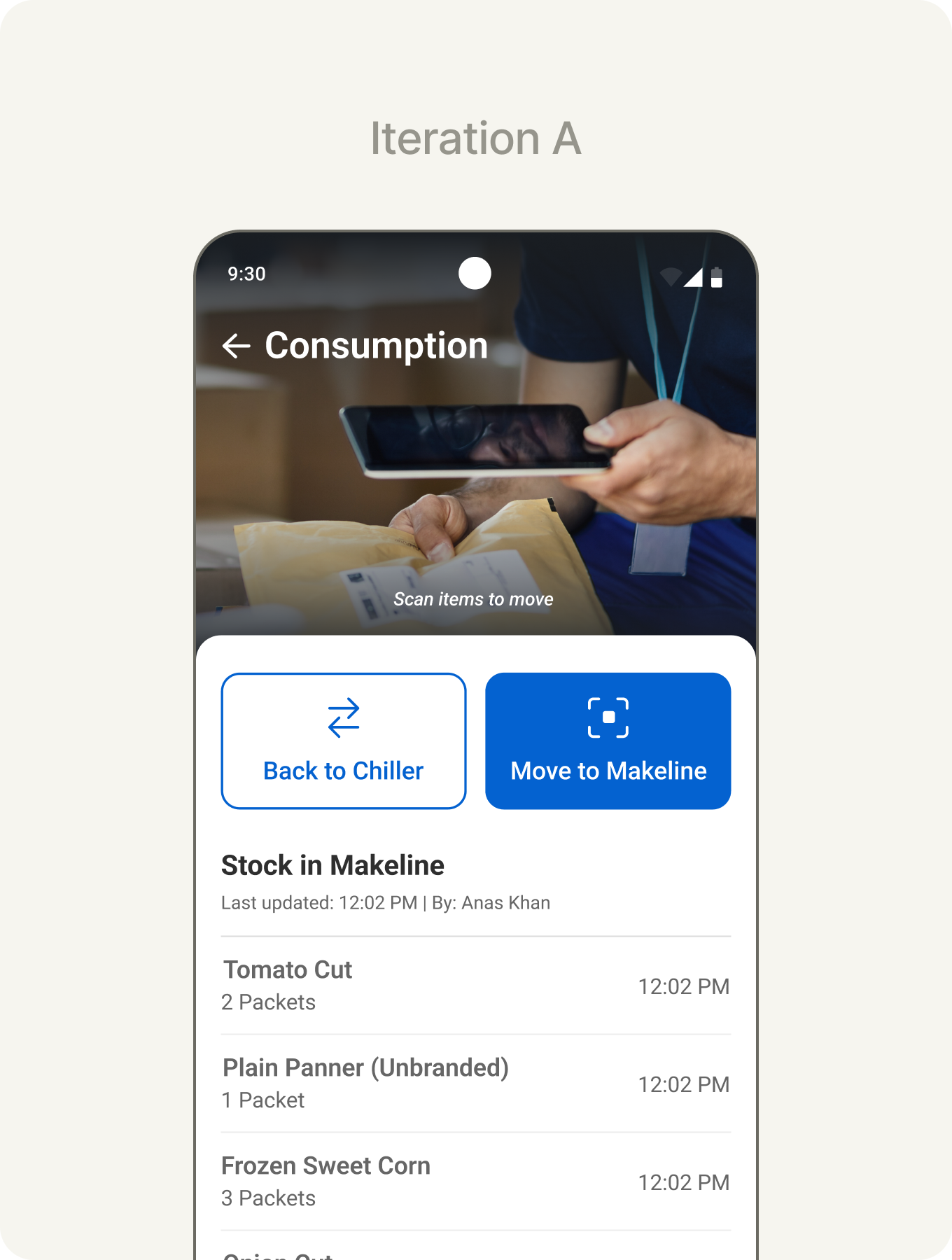
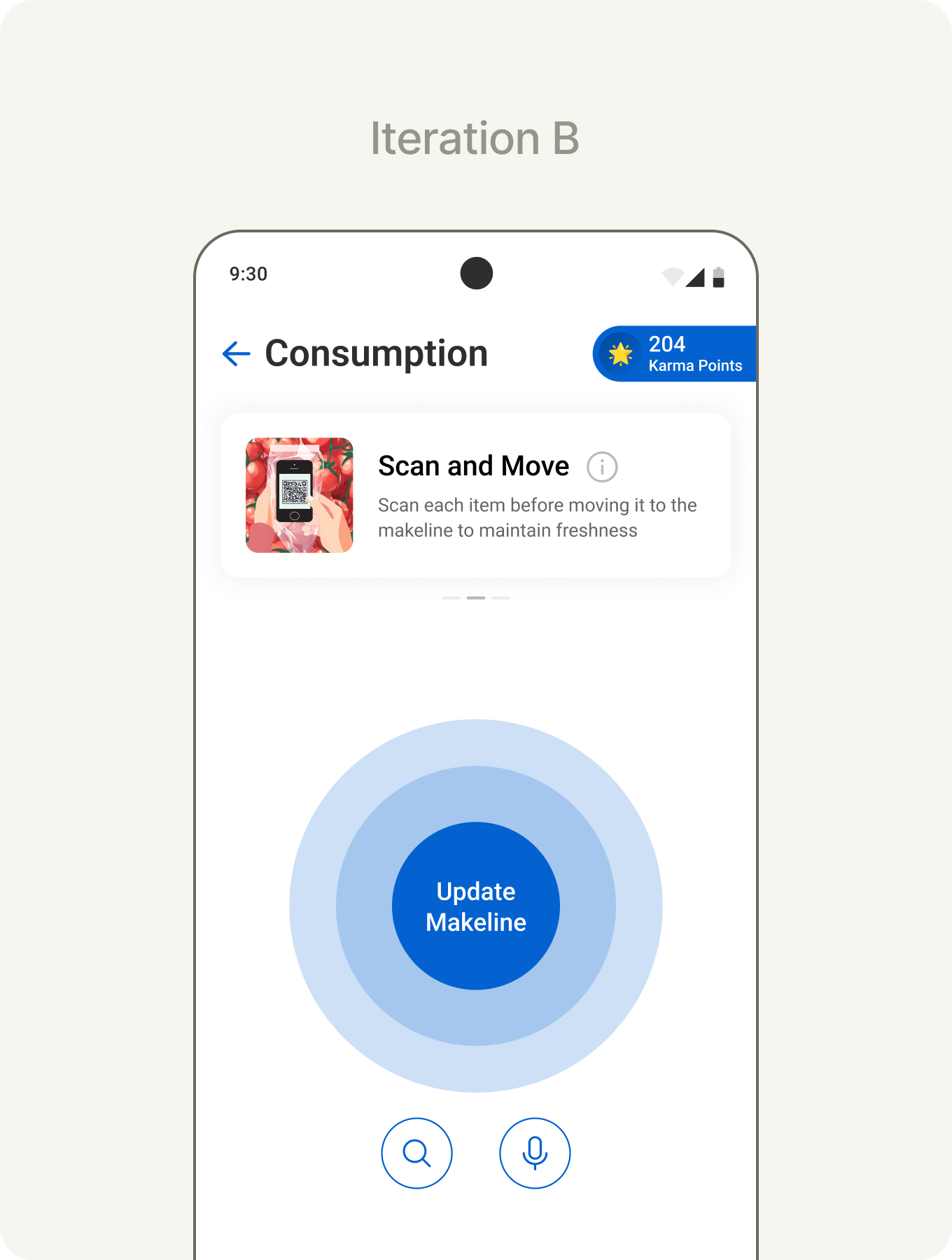
Across multiple iterations, two key directions emerged: Iteration A offered detailed inventory visibility and explicit actions, improving control but increasing cognitive load; Iteration B reduced the task into a single action, optimising for speed but removing critical context needed for trust.
Guided Scan to Move for Visibility
Designed a QR-based consumption tracking system where all ingredients are scanned before moving them to the make line as part of SOP. This creates real-time visibility into stock movement and sets up a structured way to prevent chaos during peak hours & reduce wastage.
System Checks for Product Quality
During scanning, the system validates FIFO and expiry rules, helping maintain product quality while ensuring older stock was consumed first.
Designing for Compliance
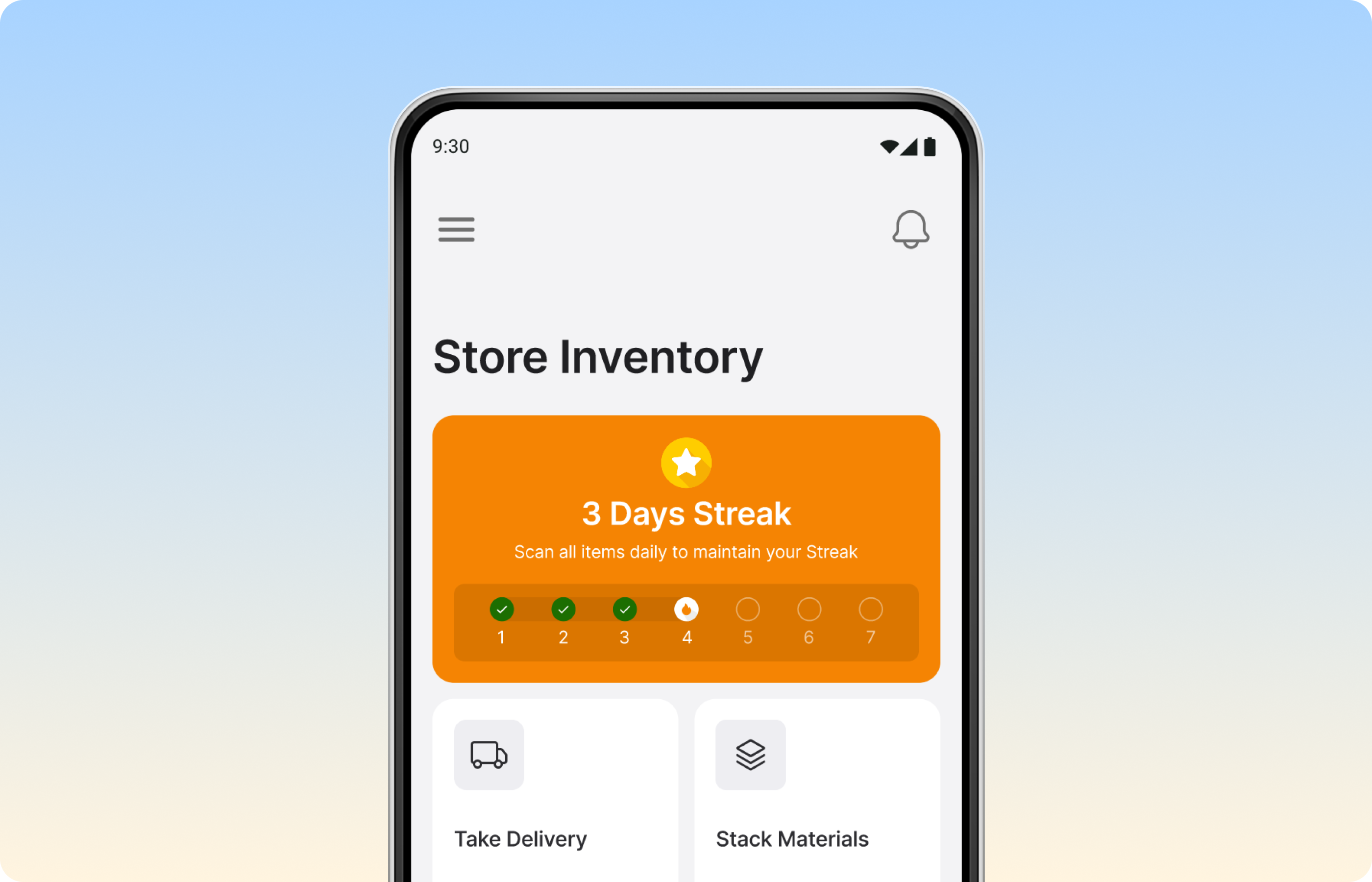
We identified and solved for bad behaviours such as skipped scans, ignored expiry alerts, and SOP non-adherence by the store staff. To discourage misuse, non-compliant stores were required to reconcile stock daily instead of weekly, creating a tangible operational consequence.

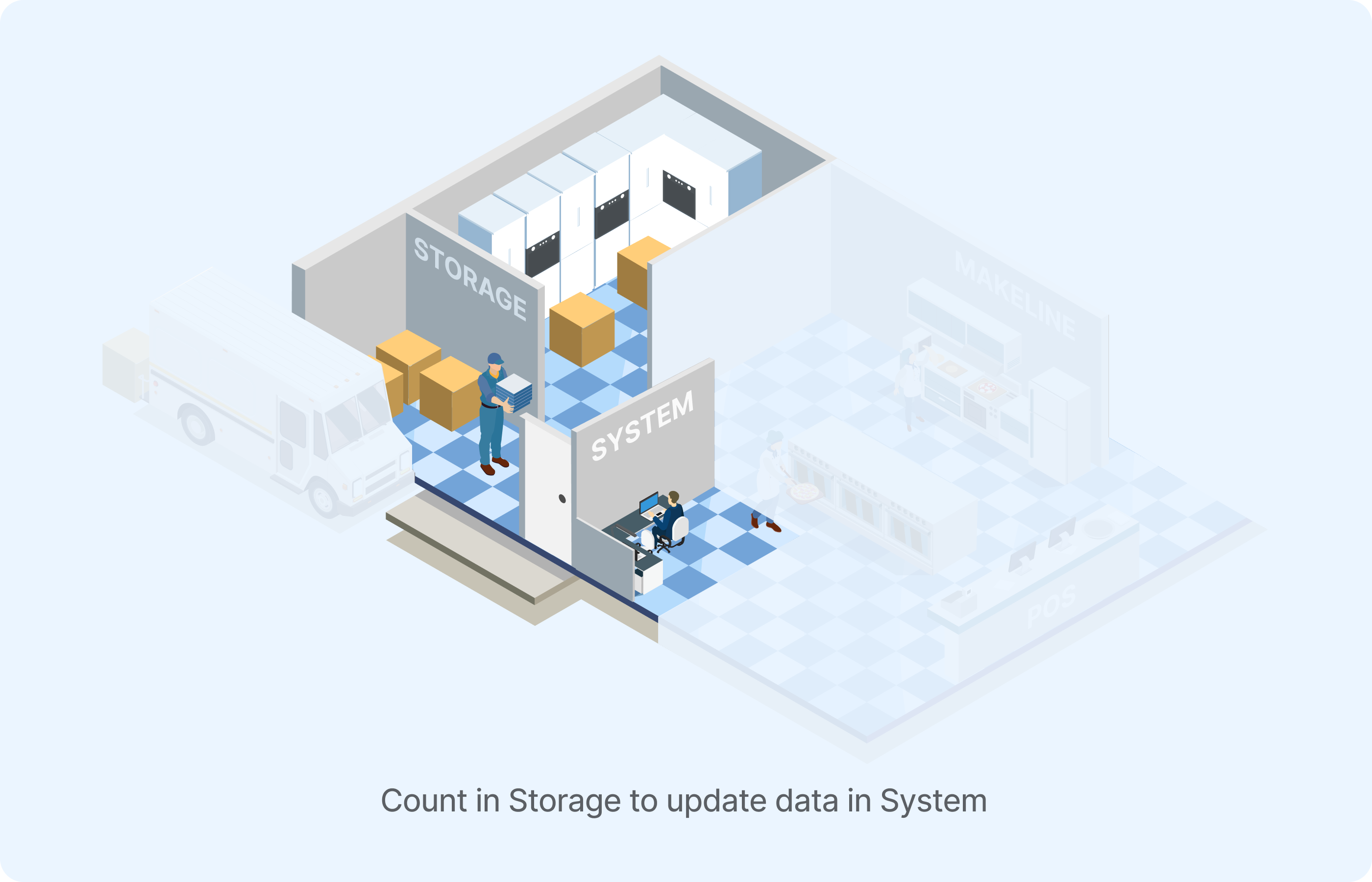
Module 2: Stock Reconciliation
Physically counting store inventory and matching it with system records to correct discrepancies. Earlier, staff were required to count every item daily after closing, which often led to skipped checks and inaccurate entries.
Constraints
For reconciliation, the hardest constraints were fatigue at end-of-day, high SKU volume, and low incentive alignment. These made accuracy difficult even for well-intentioned staff.
Debating the Direction
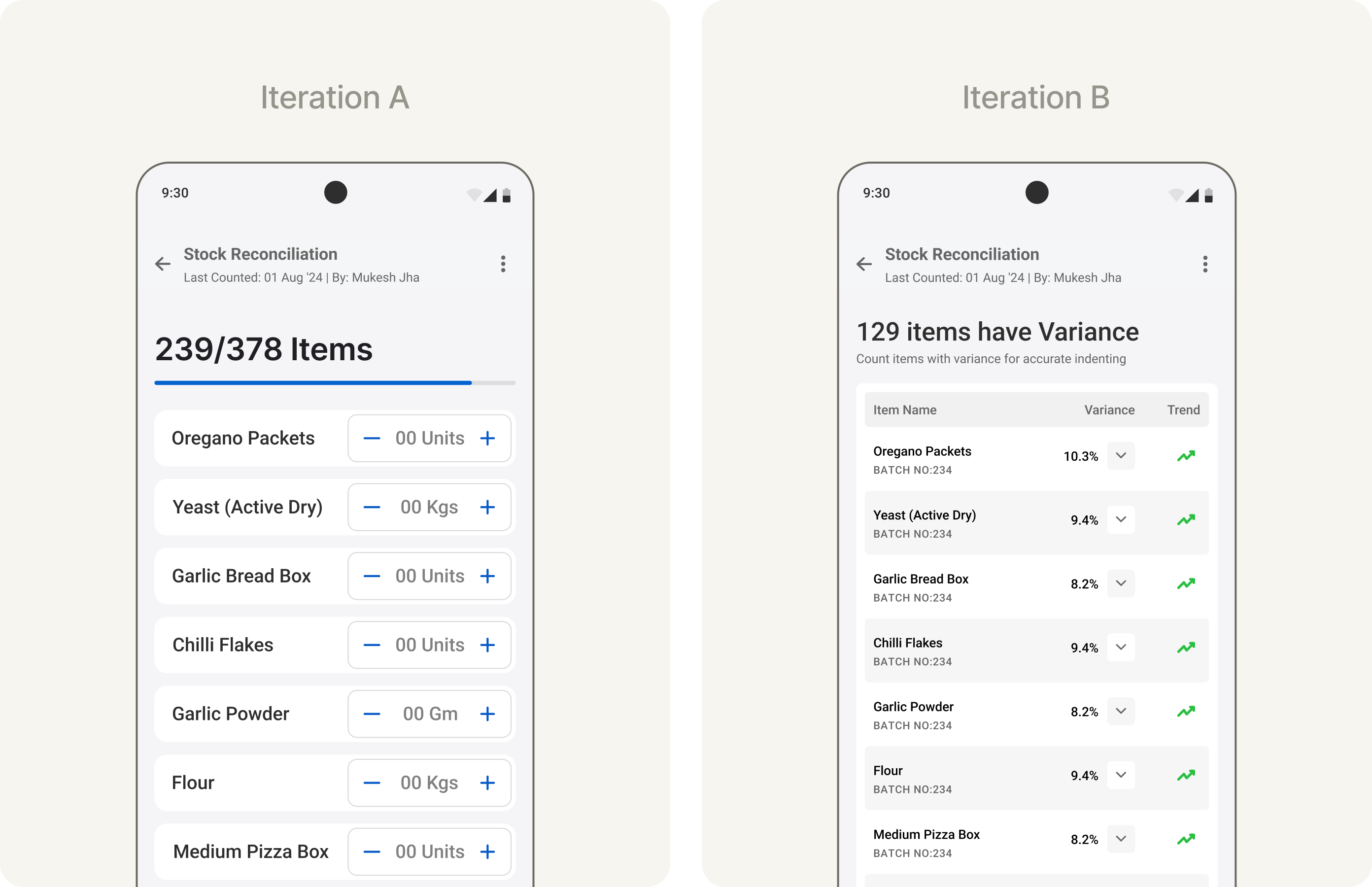
Explored three directions: a checklist style counting flow that was fast but error-prone, a guided process that gave training ease, and an exception-led flow that showed only mismatches and relied on data trust. We finalised the guided flow as it balanced speed, accuracy, & high attrition
View Full Project

Cyclic counting built into daily operations
We simplified the system by organising inventory by storage areas and item categories. Since Food and Pie drove 95% of wastage and stock-outs, items were split into critical and non-critical to focus daily effort. Stores were tiered by compliance to enable consistent, low-effort execution
Guided adjustments with structured reasons
When a discrepancy was found, the system guided managers through a simple adjustment flow. Predefined reasons like wastage, spillage, or entry error replaced free-text notes, creating consistency and an auditable trail. This helped identify recurring operational issues over time.
Step-by-step flow to reduce training time
Each stage was broken into clear, sequential steps, guiding users forward instead of exposing all controls at once, reducing training needs in high-turnover store environments. Large, scannable cards, big tap targets, and thumb-friendly actions kept the flow intuitive on the shop floor.
Side Note
Staying flexible was key to navigating ambiguity in a legacy system, rather than following a single rigid process. This project helped me truly understand the massive scale at which Domino’s operates and design solutions that respected real-world constraints. I also gained deep exposure to operations, learning how to design for a complex system while making the experience feel simple and intuitive for non technical users.
View Full Project
Explore More Work
Aftertaste: Customer Resolution Platform

Elate: Domino’s Customer Facing Point of Sale

© 2026 Prakruti Desai
Home
Next Project

Next Gen Inventory Management
Inventory tracking across 2,500+ Domino’s stores relied heavily on manual registers, Excel and other legacy tools, making it unreliable at scale. The project focused on digitising inventory in a way that worked in fast pace kitchen environment reducing wastage without slowing operations.
Year
2025
Type
B2B • Systems Design • Gamification
Impact
+$7.7M in annual revenue projected
Collaborators
2 Product Designers + 1 Design Researcher + 1 Design Manager + 2 Product Managers + Engineering Squad + Operations Team + Master Data Management Team
My Role
I partnered with our researcher to study on-ground workflows through observations and staff interviews, then worked with PMs on system mapping and solution framing. I owned end-to-end UX, from concept to high-fidelity prototypes for consumption and stock reconciliation modules.

Start
Test
Discovery and Synthesis
Design and Prototyping
Ideation
Feasibility Validation
Staff, Operations, PMs, Designers
Designers
Operations, PMs, Designers
CPO, MDM, Eng, PMs, Designers


Goal
Improve inventory accuracy and visibility across stores to reduce wastage and leakage, unlocking meaningful cost and time savings at scale.
Problem
At Domino’s scale, accurate inventory data was critical for daily ordering decisions but the systems generating that data relied heavily on manual effort leading to stock outs, over ordering and revenue leakage.
Solution
A low-friction, QR-based inventory tracking system was designed to capture stock movement in real time, fitting seamlessly into existing kitchen workflows without slowing staff down. Maker checker was added to reduce misuse, & key tasks were lightly gamified to keep staff motivated.

Module 1: Consumption
Consumption is the usage of materials as they move from storage to the makeline. This movement wasn’t tracked in real time leading to wastage, and reactive decision-making.
Constraints
The system had to work during peak-hour pressure, where staff couldn’t absorb additional cognitive or operational load. It also needed to be easy to learn and adopt in a high-turnover store environment.
Constraints
For reconciliation, the hardest constraints were fatigue at end-of-day, high SKU volume, and low incentive alignment. These made accuracy difficult even for well-intentioned staff.
Debating the Direction
Across multiple iterations, two key directions emerged: Iteration A offered detailed inventory visibility and explicit actions, improving control but increasing cognitive load; Iteration B reduced the task into a single action, optimising for speed but removing critical context needed for trust.
Guided Scan to Move for Inventory Visibility
Designed a QR-based consumption tracking system where all ingredients are scanned before moving them to the make line as part of SOP. This creates real-time visibility into stock movement and sets up a structured way to prevent chaos during peak hours & reduce wastage.
System Checks for Product Quality
During scanning, the system validates FIFO and expiry rules, helping maintain product quality while ensuring older stock was consumed first.
Designing for Compliance
We identified and solved for bad behaviours such as skipped scans, ignored expiry alerts, and SOP non-adherence by the store staff. To discourage misuse, non-compliant stores were required to reconcile stock daily instead of weekly, creating a tangible operational consequence.
Module 2: Stock Reconciliation
Physically counting store inventory and matching it with system records to correct discrepancies. Earlier, staff were required to count every item daily after closing, which often led to skipped checks and inaccurate entries.
Constraints
For reconciliation, the hardest constraints were fatigue at end-of-day, high SKU volume, and low incentive alignment. These made accuracy difficult even for well-intentioned staff.
Debating the Direction
Explored three directions: a checklist style counting flow that was fast but error-prone, a guided process that gave training ease, and an exception-led flow that showed only mismatches and relied on data trust. We finalised the guided flow as it balanced speed, accuracy, & high attrition
View Full Project
Cyclic counting built into daily operations
We simplified the system by organising inventory by storage areas and item categories. Since Food and Pie drove 95% of wastage and stock-outs, items were split into critical and non-critical to focus daily effort. Stores were tiered by compliance to enable consistent, low-effort execution
Guided adjustments with structured reasons
When a discrepancy was found, the system guided managers through a simple adjustment flow. Predefined reasons like wastage, spillage, or entry error replaced free-text notes, creating consistency and an auditable trail. This helped identify recurring operational issues over time.
Step-by-step flow to reduce training time
Each stage was broken into clear, sequential steps, guiding users forward instead of exposing all controls at once, reducing training needs in high-turnover store environments. Large, scannable cards, big tap targets, and thumb-friendly actions kept the flow intuitive on the shop floor.
Side Note
Staying flexible was key to navigating ambiguity in a legacy system, rather than following a single rigid process. This project helped me truly understand the massive scale at which Domino’s operates and design solutions that respected real-world constraints. I also gained deep exposure to operations, learning how to design for a complex system while making the experience feel simple and intuitive for non technical users.
View Full Project
Explore More Work
Aftertaste: Customer Resolution Platform
Elate: Domino’s Customer Facing Point of Sale

Home
Next Project